Gardening Holidays: Sneak Some Zucchini Onto Your Neighbor’s Porch Day
Today is Sneak Some Zucchini Onto Your Neighbors’ Porch Day – HOW FUN. I happened up on these great beauties for free at our local bee supply shop. We’ve been keeping up with ours, so this gave me the perfect fodder to celebrate this holiday!

Mr Chiots ran in to town yesterday afternoon (since I needed photos for today, we celebrated a day early). He put them on our friend’s porch, right on the porch swing.

Unfortunately he was caught in the act. Ollie, their crazy little dog wanted to keep the zucchini (I’m sure he thought it was a dog toy).

In the end the zucchini is back at our house (our friend’s don’t appreciate zucchini as much as we do). I sauteed it last night and it’s marinading in a balsamic vinaigrette in the fridge. We’ll enjoy it as a side dish, on pizza, or on a sandwich.
Are you going to celebrate this fantastic holiday (if so, snap a photo, put it on your blog, and link to it in the comments)?
Share this:

My Mom’s Garden
This year we planted some popcorn at my mom’s house in her garden. She gets a lot more sun than we do, so she offered to expand her garden so we could have some space over there. We planted popcorn quite a while ago. While over for a visit on Wednesday, I took a photo of our lovely corn.

We’re keeping our eye on it, as soon as ears start to form we’re going to put an electric fence around it. My parents have always had trouble with coons in the corn. If you notice the pumpkin vines growing through the corn, this is a ‘Rouge Vif d’Etampes’ Cinderella pumpkin from my saved seeds. There are a few pumpkins set on the vines, I can’t wait to see them this fall (unless the deer get them like they did last year).

My mom’s garden is looking quite nice this time of year. This is what it looked like 2 months ago? As you can tell by the brownish color of everything, it’s been a little dry for the past couple weeks.
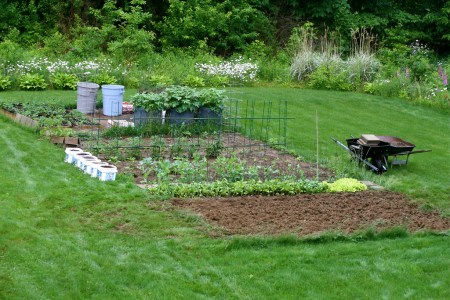
It’s always nice to have photos so you can see how well the garden is doing.
How do you monitor your gardens growth?
Share this:

Another Reason to Grow Your Own!
My friend Shaun mentioned that while out running one day he spotted a truck spraying something on a local field.

He assumed it was liquid manure at first, which is common to see farmers spraying on their fields. A closer look revealed something interesting.

That truck reads, “Brown Township Malvern Sewer District”. A couple days later he noticed a new sign had been placed kind of behind a tree, down on one corner of the field.

Sewer Sludge is defined as: an unpleasant material whose the quantities increase each year. According to the Center for Food Safety, this is what’s going on:
Every time you flush your toilet or clean a paintbrush in your sink, you may be unwittingly contributing fertilizer used to grow the food in your pantry. Beginning in the early 1990s, millions of tons of potentially-toxic sewage sludge have been applied to millions of acres of America’s farmland as food crop fertilizer. Selling sewage sludge to farmers for use on cropland has been a favored government program for disposing of the unwanted byproducts from municipal waste water treatment plants. But sewage sludge is anything but the benign fertilizer the Environmental Protection Agency says it is.
Sewage sludge includes anything that is flushed, poured, or dumped into our nation’s waste water system–a vast, toxic mix of wastes collected from countless sources, from homes to chemical industries to hospitals. The sludge being spread on our crop fields is a dangerous stew of heavy metals, industrial compounds, viruses, bacteria, drug residues, and radioactive material. In fact, hundreds of people have fallen ill after being exposed to sewage sludge fertilizer–suffering such symptoms as respiratory distress, headaches, nausea, rashes, reproductive complications, cysts, and tumors.

So I googled Class B sewer sludge to see what we were dealing with and I found this sickening bit of information:
Sludge is classified as either Class A or Class B, depending on the type of treatment it has received. Class A sludge has benefited from both pretreatment and treatment at the wastewater facility. The pathogens in Class A biosolids cannot exceed certain levels set by the EPA. Standards for Class B sludge are less stringent, and their use is therefore more regulated. A landowner who wishes to use Class B sludge as an alternative to conventional fertilizers must apply to the Texas Commission on Environmental Quality to register his site. Among other items, the application requires information on the type of land, the amount of buffer zones, and the type of soil. The applicant must also provide information from the wastewater treatment facility on the type of pollutants and pathogens in the sludge, and calculations of nutrient needs for the crops. The use of Class B sludge on land has been criticized by the Center for Disease Control and the National Institute for Occupational Safety and Health. A landowner using Class A sludge does not have to register his land.
After searching a while for information I came across a few articles I though you might find interesting if you want to read more about the use of sewer sludge in agriculture.
* Here is a great article about sewer sludge.
* Another story about sewer sludge usage on hay that was fed to cows that resulted in their death, over at the Organic Consumers Association.
* Even the White House garden has been contaminated with sewer sludge.
* Bio-solids: by any other name, Sludge
* Sludge News: a website dedicated to information about and activism against the use of sewer sludge. Including a list of fertilizers sold at Hardware stores that contain sludge.

This is why I want to GROW MY OWN and keep as closed a system as possible in my gardens. I’ll put homegrown compost on my gardens thanks!
Did you know that sewer sludge was used in agriculture, particularly on the food we eat?
Share this:

Homegrown Medicine: Comfrey
I grow a few herbs in my garden can be used medicinally. I’m not really into using herbs as medicine all that much, but it is an area that interests me and one that I will be researching more in the coming years. I grow rosemary and oregano to use when I’m congested and sick, I usually brew up some tea or breathe some in steam. On Sunday I gave myself a nasty cut while harvesting peppers. You see, I always use my Super Shears to harvest things, and they’re quite sharp. I accidentally cut about 1/3 of the way through my pinky finger on Sunday. I didn’t take any photos, although Mr Chiots said a photo of the bloody pepper plants would be great for the blog. All I have a photo of the scissors for you, so no need to avert your eyes (noticed the bandaged finger).

I’ve always heard that comfrey speeds healing of not just cuts and bruises, but also broken bones. I happen to have a large comfrey patch, so on Monday afternoon I grabbed a few leaves and made a poultice for my cut. I put a butterfly bandage of my finger followed by a nice smear of comfrey poultice, then a big bandage on top. I must say, the cut quit hurting almost immediately.

I haven’t had any pain since I applied the comfrey (it was throbbing before I did) and when I re bandaged yesterday it was looking quite well. I’ll probably leave it bandaged for a few more days, but from what I hear it should be fairly well healed by tomorrow with the power of comfrey.
Do you grow or use any herbs for medicinal purposes?
Share this:

Book Report: The Unhealthy Truth
 I’ve been reading The Unhealthy Truth: How Our Food Is Making Us Sick – And What We Can Do About It
The first 7 chapters are spent detailing the information Robyn found during her research into GMO (Genetically Modified Organisms) and artificial chemicals, preservatives, and dyes in manufactured foods and the link between these and allergies, autism and other immune diseases. I won’t recount the information here, read the book for all the gory details. You might be interested to know that the top 12 GMO foods in production the United States are: corn, cotton, potatoes, tomatoes, soybeans, canola, sugar beets, rice, flax, squash/zucchini, papaya and chicory (radicchio). I knew about corn, soy, sugar beets, cotton and canola, but I was surprised by the other crops on the list. Yet another reason to shop locally and grow your own!

The last chapter, however, is a HUGE let-down as she details her “meal-plan” for getting your family on the healthier eating road. I was excited to hear about her great ideas of incorporating fresh organic food into her new diet, but her new diet is just like her previous one, she just switched conventional processed food for organic processed food. I’m sure organic processed food contains fewer chemicals than conventional, but this doesn’t really get to the root of our screwed up country-wide eating disorder. We no longer eat “REAL” food; none of our food looks like it does in it’s natural form and most of it is processed, comes in a box and is shipped thousands of miles. Are organic processed packaged granola bars really a healthier option than an in season peach from a local farm? Her meal plan is also severely lacking in the area of fresh fruits & veggies, not even getting close to the 7-11 servings a day we should be getting.

I also completely disagree with her statement that eating organically and healthfully are more expensive than eating conventional boxed food. Sure if you’re just switching all of your processed food from regular to organic you’re going to pay more for it. But if you buy real fresh food that’s in season it’s actually much much cheaper!


Buying fresh local apples is a better investment nutritionally than buying a bag of chips and you’ll get more servings out of it (not many people sit down and eat 3 apples at once, but many people will sit down and eat 3 servings of chips). A better cheaper option is buying locally grown fruit and veggies in season. A .75 zucchini from the farmers market (or picked in your back yard) that will serve 5 really is much cheaper than that bag of organic baby carrots you buy each week at the grocery store (and much fresher).

I do love that she mentions getting your kids involved in the process of healthier eating, which is very important. Here’s an idea: instead of buying all the expensive organic processed food at the grocery why not load up your kids and head to the farmers market. Let them each pick out one new veggie each week and get them involved in choosing their own healthy food. Not only is this local food much healthier because it’s fresh and local, but it’s much cheaper than grocery store food. You could also try growing a few veggies in pots on your front/back porch. It’s amazing how willing kids are to try something new if they’ve nurtured it from a seedling.

I believe buying good quality local organic produce is an investment in your health and in your future (not to mention it tastes much better as well). It’s also very important for the preservation of our farmland. In the last couple years as we transitioned to local whole foods we actually started spending less on our groceries (and that includes buying $8/gallon raw organic milk). There are a lot of things I would go without in order to eat good quality food, cable, cell phone, the second car, vacations, new clothes, eating out, etc, but I don’t have to because I’m actually spending less on my healthy diet. Some things are more expensive, like dairy & meat, but we eat a little less of them and the savings from buying in season fruits and veggies helps off-set the cost. There’s great peace of mind knowing that you’re feeding yourself in the healthiest way possible, giving yourself and your loved ones the best chance to live a long healthy happy life.


I would highly recommend reading this book, but only if you’re ready to making changes in your diet. If you don’t want to hear about all the chemicals, pesticides, and genetically modified organisms lurking in your processed foods and the health problems they cause, do not read this book. Ignorance is bliss, at least for a while.
Are you taking steps to cut out GMO’s and trying to include more whole real foods in you diet?

