Heirloom Tomato Seeds from WinterSown
A couple weeks ago I found out about Winter Sown on Annie’s Kitchen Garden. Wintersown will send you free heirloom tomato seeds for nothing more than a self addressed stamped envelope. They have a list on their website and you choose 6 kinds that you would like and some alternates (in case they don’t have the ones you want). I was super excited when I looked through their list because they had Tumbling Tom as one of their options and Principe Borghese as well. I was hoping to find Tumbling Tom tomatoes because I want to try growing them in hanging baskets on my front porch. Principe Borghese are superb drying tomatoes, so I was hoping to find these to dry for winter use.

I sent off my SASE last week and I received my seeds on Monday. When I opened up my envelope I was delighted to not only find my first 6 choices of seeds, but some of my alternate choices as well and some cucumber and parsley seeds.

They also included a brochure with directions on how to save your own seeds and they encourage you to send in your saved seeds so they can give them to others. What a great idea! I have saved tomato seeds for a few years, it’s super easy. This summer I saved a few from some farmer’s market tomatoes. I made sure to ask if they were heirloom plants. I’ll have to save a bunch and send in my extras this fall.

What seeds did I receive?
Cherokee Purple ~ Deep, dark rose-tone beefsteak, known for great flavor, most fruits over a half pound, IND, about 80 DTM
Cold Set ~ Canadian saladette has red fruits up to four ounces, fast and early, DET, about 65 DTM
Tumbling Tom ~ Loads of red cherries on dwarf plants are perfect for pots or hanging containers, DET, about 70 DTM
Costoluto Genovese ~ Italian heirloom has ribbed fruits, about 5 – 7 ounces, IND, 90 DTM
Roller Coaster Cherry Tomato Mix ~ Delicious and colorful blend made from varieties of cherry, pea, currant, wild types and rarities; 10+ seeds per pack, IND, 70 – 85+ DTM
Azoychka ~ Lemon-yellow beefsteaks can weigh about a half-pound, yummy early cropper, IND, 70+ DTM
Principe Borghese ~ great drying tomato, DET, about 75 DTM
White Beauty ~ Creamy white, meaty and delicious, most about a half pound, IND, 85 DTM
Kitchen Herb: Parsley
Marketmore Cucumber
I’m super excited about trying all these different kinds of tomatoes. I really want to grow San Marzano as well, but those may have to wait till next year. I’ll be starting these seeds in a month or two and I’ll probably give all the extra plants to my mom. I’ll keep you posted on how they do.
What are you favorite tomato varities? Have you ever saved seeds from you tomatoes?
Share this:

Guess What’s Coming this Spring
Guess what I’m reading up on for the new addition to the gardens here Chiot’s Run?

That’s right, beekeeping. I’m hoping to join a local beekeeping club and get my first hive this spring. My grandpa & dad used to keep them and my dad has a box hive he’s going to give me. It’s painted bright white and it has a copper roof, it will be lovely in the garden (and I’m going to be quite smashing in that hat).

I think this will be a great addition to our gardens. I always buy local honey from local beekeepers, but I would like to make my own. That way I know that it won’t have pesticides or chemicals in it. Warren from My Home Among the Hills keeps bees. I’m sure if I have any questions he’d be happy to help.
Anyone else out there keeping bees? Or do you just buy local honey?
Share this:

Foraging for Food
Today’s society has largely drifted –no, better to say “hastened” or “rapidly run” —away from a lifestyle that forages, hunts and grows their own, and then cooks from scratch. From the time women went to work in the early 1950’s and got out of the kitchen (and garden), the door has been opened for processed and fast food purveyors to enter, so that now, in 2008, those in the under-50 crowd who know how, and actually enjoy, cooking are becoming rarer and rarer. It is easier to open a box, add water, heat and serve.
This crowd is in for a rude awakening, and it seems to be coming sooner rather than later.
Dr. Peter Gail, Ph.D (Goosefoot Acres Center for Resourceful Living)
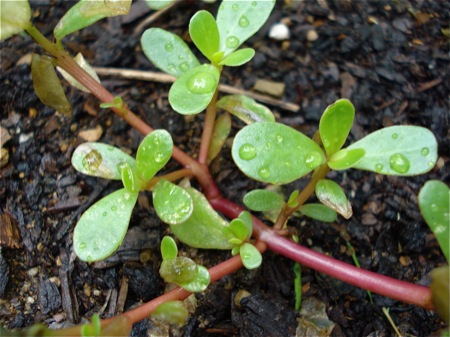
Purslane contains more Omega-3 fatty acids than any other leafy vegetable plant.
It’s interesting when you start identifying and studying weeds. Many of them are actually edible plants that were brought here by our ancestors for their nutritional and medicinal purposes. It’s interesting that as grocery and drug stores became more available to the common people, the knowledge of the medicinal and nutritional uses of common weeds was lost. Here’s an excerpt from his article, to read the entire article visit Doc Weed’s Doin’s.
The answer is as simple as opening our eyes and looking around to see what has been invisible up to now. More specifically, stand on a proper untreated lawn—one that hasn’t been treated with chemicals and still has all the plants in it —and look down at the ground beneath your feet. For, right there, in most cases, you will find between 4 and 6 vegetables that are tastier when prepared properly and more nutritious than anything you can buy in the store. During the Great Depression and World War II, when food was rationed or unavailable, many mothers fed their families very successfully on these plants.
Where did these vegetables come from? In most cases, they were brought to America by our ancestors, mostly at the behest of the emigration companies sponsoring them who would tell them to bring seeds of all the plants they valued for food and medicine with them, because who knew whether they would find them in this new land.
So dandelions, plantain, lambsquarters, red root pigweed, purslane and many other plants came with every shipload of immigrants. Plantain was so valuable that it traveled with them to every early English and Scottish settlement. Before they arrived, there had been no plantain. After, they were so common that the Natives called the plant “White Man’s Foot”.
The bottom line is that 80% of the plants we call weeds and pay millions for chemicals to eradicate each year are really the vegetables and medicines our ancestors made great sacrifices to bring here for us to have. Each group had different ones, however, and as the seeds escaped from their gardens, they entered other gardens in which the inhabitants didn’t know their value, and so to them they were a nuisance, and had to be eliminated.

Mr Chiots and I gather berries in the summer and we have picked apples by the side of the road, but not much else. I do eat the purslane that grows in my flowerbeds. This spring I’m going to try some garlic mustard which is rapidly becoming an invasive weed in the areas surrounding our home. I’m also hoping to try some dandelion greens (they sell them at our local grocery store for $5 a pound). It’s definitely an area that’s interesting to me, I may read up on it some more this winter and try to identify a few more edible and medicinal plants this summer. I’ll keep you posted on what I find and how they taste or work.

Any foragers out there? Have you ever eaten something you picked from the side of the road? (take the poll)
Share this:

Feeling Right at Home
Dexter’s feeling right at home here at Chiot’s Run. He’s enjoying having food all the time and living inside a warm & toasty house.

He’s decided he really likes the domesticated life, especially the posturepedic mattress he gets to sleep on all day. Samson (our orange cat) is enjoying having a new playmate, we hear them often running up and down the hall. Dexter’s even decide that Lucy’s OK and he no longer hisses at her.

We’re enjoying having Dexter around as well. He adds a new dynamic to the household; he has a great personality and he’s very talkative.
He’s quite a cutie isn’t he?
Share this:

Gardening Quote: Thomas Jefferson
“Cultivators of the earth are the most valuable citizens. They are the most vigorous, the most independent, the most virtuous, and they are tied to their country and wedded to it’s liberty and interests by the most lasting bands.”
-Thomas Jefferson

Monticello Gardens and Pavilion by Mr T in DC
Anyone ever visited Monticello? It’s one of those places I would love to visit but haven’t had the chance.

